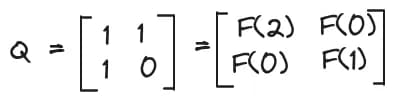
You’re probably familiar with the Fibonacci sequence. After all, it is commonly used to illustrate the concept of recursive functions to new programmers.
There are two well-known ways to calculate the n-th Fibonacci number: recursion and iteration. However, thanks to Leetcode, I’ve learned of another solution: use matrix multiplication.
However, this solution starts with the concept of the Fibonacci Q-Matrix: [[1, 1], [1, 0]]. They didn’t explain any further what this matrix means, or how does one come up with this matrix!
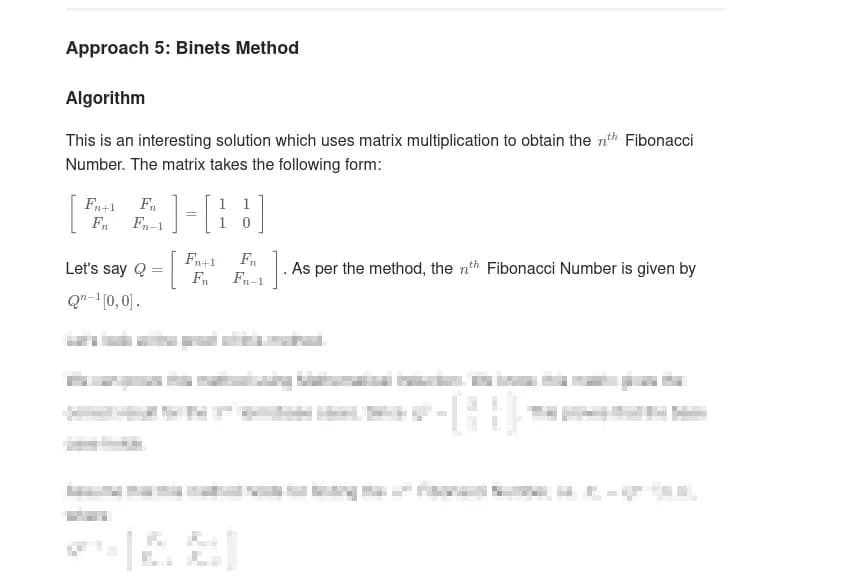
The entry for Fibonacci Q-Matrix on Wolfram Mathworld is no better.
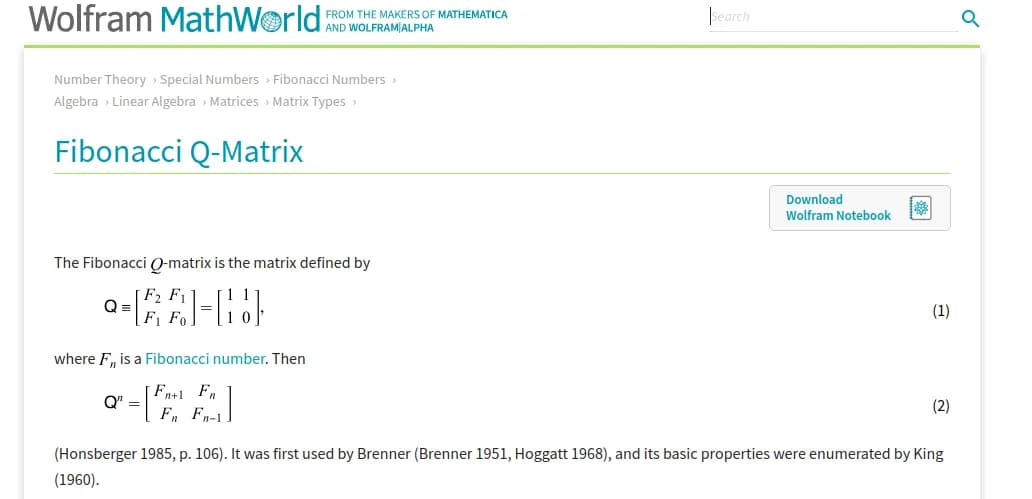
Do we have to accept this definition as it is, without any explanation? The problem is that if I don’t at least understand this matrix conceptually, it will soon be erased from my short-term memory.
Fret not, I’ve found an easy way. As you already know, to calculate a Fibonacci number at at position, we need to know two numbers before it. Let’s call this first and second. Some sources use the term previous and current, but I found that even more confusing.
Once this is done, how do we get the next value? We advance the first and second values to the right.
first is discarded, second becomes first, and what was the result becomes second.
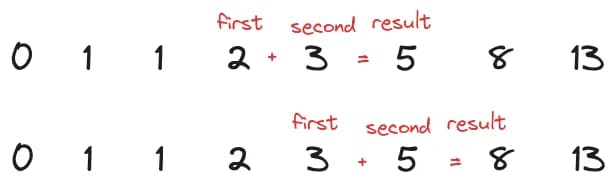
The new assignments will be written like this in cseudocodes:
second(n + 1) = result = second(n) + first(n)
first(n + 1) = second(n)
It is even more obvious when we write it in terms of linear equations:
second(n + 1) = 1 * second(n) + 1 * first(n)
first(n + 1) = 1 * second(n) + 0 * first(n)
And the linear equations above can be rewritten with matrix:
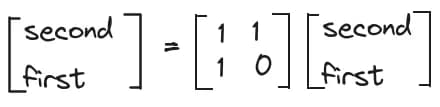
The matrix here is called the Fibonacci Q-Matrix. So what is the significance of this matrix?
Fibonacci Q-Matrix brings the number from n-th position the n+1 -th position.
Recall that a Fibonacci sequence is 0, 1, 1, 2, 3 etc. So F(0) = 0, F(1) = 1, F(2) = 1. We can replace the numbers in the matrix with the Fibonacci numbers.